

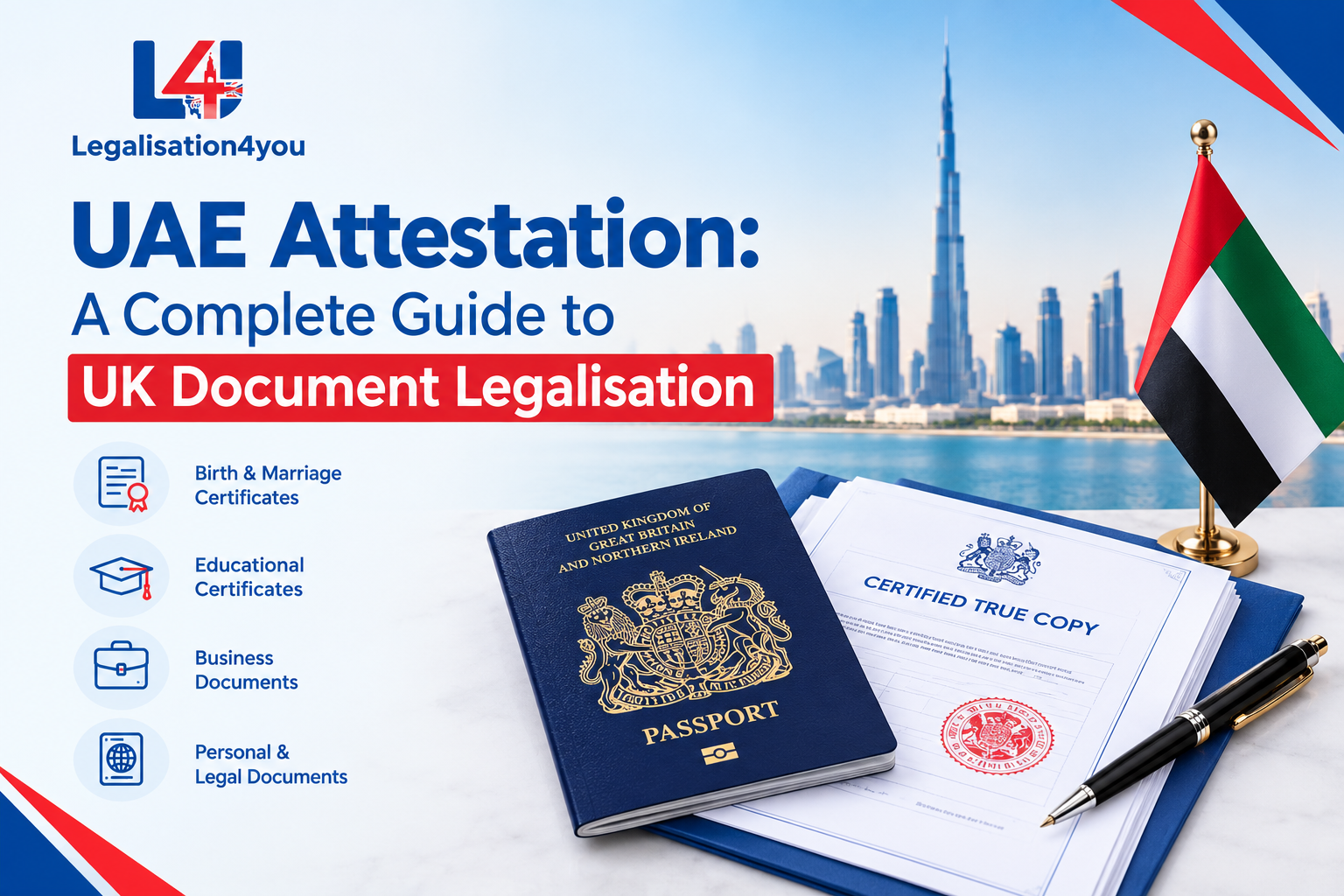
When you plan to work, study, live or conduct business in the United Arab Emirates (UAE), you may need to provide official UK documents to government authorities, employers, educational institutions or other organisations. Before these documents can be accepted, they may need to go through a legalisation process known as UAE attestation.
Understanding the requirements in advance can help you avoid delays, unnecessary expenses and rejected applications. Whether you need to legalise a birth certificate, marriage certificate, degree certificate or business document, it is important to follow the correct procedure for your document type and intended use.
This guide explains what UAE attestation means, which documents may require it, how the process works in the UK and how to prepare your paperwork for use in the UAE.
What Is UAE Attestation?
UAE attestation is the process of verifying the authenticity of a document, signature, stamp or seal so that it can be recognised by the relevant authorities in the United Arab Emirates. It helps receiving organisations establish that a document has passed through the required authentication procedures.
For UK-issued documents, the process generally involves legalisation by the UK Foreign, Commonwealth & Development Office (FCDO), followed by the relevant UAE attestation procedure. Depending on the document and the current requirements, the process may involve a UK solicitor or notary public before the document is submitted for legalisation.
The purpose of attestation is to establish the authenticity of the document rather than to verify that every statement within it is factually correct. The receiving authority ultimately determines whether the document meets its requirements.
People commonly need UAE attestation when relocating to the UAE for employment, applying for a family visa, continuing their education, getting married or establishing a business.
Why Do You Need UAE Attestation for UK Documents?
Documents issued in the UK may not automatically be accepted by UAE authorities. Legalisation helps confirm the authenticity of official signatures, seals and certifications so that the documents can be used for their intended purpose abroad.
Some common reasons for needing attestation include:
-
Employment: Employers may request authenticated educational certificates, professional qualifications or other supporting documents.
-
Family visa applications: Birth and marriage certificates may need legalisation to establish family relationships.
-
Education: Schools, universities and professional bodies may request attested academic certificates and transcripts.
-
Marriage and personal matters: Official certificates may need authentication for registration or administrative procedures.
-
Business activities: Companies may need to legalise contracts, incorporation documents, powers of attorney and other commercial paperwork.
-
Legal procedures: Certain court documents and legal instruments may require authentication before they can be used in the UAE.
The exact requirements depend on the organisation requesting the paperwork and the purpose for which it will be used. Before beginning the process, confirm whether original documents, certified copies or notarised documents are required.
Which UK Documents May Require UAE Attestation?
Several types of UK documents may need legalisation before being used in the UAE. The appropriate route depends on how the document was issued and the requirements of the receiving authority.
1. Educational Certificates
Educational documents are frequently required for employment, professional registration and further education. These may include university degrees, diplomas, school certificates and academic transcripts.
Some qualifications may need additional verification or certification before they can be submitted for FCDO legalisation. If you need to legalise both a degree certificate and a transcript, check whether they must be processed separately.
2. Birth and Marriage Certificates
Birth certificates may be required for family visa applications, school registrations and other official procedures. Marriage certificates may be needed when applying for a spouse visa or completing family-related administrative requirements.
UK-issued certificates generally need to meet the relevant official document requirements. Check whether the receiving authority requires the original certificate and whether any additional steps apply to your particular certificate.
3. Employment and Professional Documents
Depending on the circumstances, employment contracts, professional certificates, reference letters and other work-related documents may require authentication.
Documents that do not originate from a government registry may need to be certified by an appropriate UK solicitor or notary before they can be submitted to the FCDO.
4. Personal and Legal Documents
Powers of attorney, affidavits, declarations, court documents and certain other legal papers may require legalisation. A power of attorney, for example, may need to be signed in the presence of a UK notary or another appropriate legal professional before it is submitted for authentication.
Always check the signing and witnessing requirements before arranging an appointment, as incorrect execution can delay the process.
5. Commercial Documents
Businesses operating in or expanding into the UAE may need to authenticate company registration documents, contracts, board resolutions, powers of attorney and other corporate records.
Commercial documents can follow different procedures from personal certificates. Commercial invoices and certificates of origin may also have specific submission requirements, so it is important to confirm the correct route before proceeding.
How Does the UAE Attestation Process Work in the UK?
The process can vary depending on the document type and the applicable requirements. However, the following steps provide a useful general overview.
Step 1: Identify the Document Requirements
Start by confirming why you need the document and which organisation will receive it. An employer, university, government department or immigration authority may have particular requirements regarding the document's format, issuing authority and authentication.
Find out whether you need the original document, a certified copy, a notarised document or additional verification.
Step 2: Obtain the Correct Document
Ensure that you have the appropriate version of the document. For example, a personal certificate may need to be an official certificate issued by the relevant UK registrar rather than an informal photocopy.
Check that names, dates and other details are correct. If there are errors, you may need to contact the issuing authority before continuing.
Step 3: Arrange Solicitor or Notary Certification if Required
Some documents can be submitted directly to the FCDO, while others must first be certified by a UK solicitor or notarised by a notary public.
This step is particularly relevant to documents such as powers of attorney, declarations and certain copies of private documents. The appropriate certification depends on the document and the applicable legalisation rules.
Do not assume that every document needs notarisation. Confirm the correct route before paying for professional certification.
Step 4: Apply for FCDO Legalisation
The FCDO legalises eligible UK documents by verifying the relevant signature, stamp or seal and attaching an apostille where the document qualifies.
An apostille is an official certificate used to authenticate the origin of a public document for international use. It does not independently confirm the accuracy of the document's contents.
Before applying, check the official GOV.UK guidance for eligibility, application requirements, fees and current processing times.
Step 5: Complete the UAE Attestation Procedure
Once the required UK legalisation has been completed, the document must follow the applicable UAE procedure.
For eligible UK-issued documents, the UAE Embassy in London provides a digital attestation service that combines the relevant embassy attestation with UAE Ministry of Foreign Affairs (MoFA) attestation. The application process and eligibility requirements should be checked through the official UAE government guidance.
Some document categories have special requirements, so confirm that your document qualifies before submitting it.
Step 6: Receive and Check Your Documents
After the process is complete, check the returned documents carefully. Confirm that the correct document has been processed and that the required authentication has been applied.
Keep copies of the documents and any relevant application confirmations for your records. Follow the receiving organisation's instructions for submitting the final paperwork.
How Long Does UAE Attestation Take?
The processing time depends on the document type, the number of authentication stages required and the service selected.
For example, some documents may need preliminary solicitor or notary certification before FCDO legalisation. Others may be eligible for a more straightforward process.
Courier arrangements, incomplete applications and document verification can also affect the overall turnaround time.
If you have an employment start date, visa appointment or university deadline, begin preparing your documents as early as possible. Check the current processing estimates for each stage rather than relying on the timeframe for a single service.
Where time is limited, ask your service provider whether an expedited option is available and whether it applies to every stage of the process.
What Is the Cost of UAE Attestation?
There is no single price for every document because the total cost depends on the services required.
The overall expense may include:
-
Solicitor certification or notary public fees, where applicable.
-
FCDO legalisation fees.
-
UAE attestation charges.
-
Courier and document return costs.
-
Translation fees, if an accepted translation is required.
-
Additional verification or specialist handling for certain documents.
Before placing an order, ask for a breakdown of the services included in the quotation. This helps you understand whether the price covers the complete process or only one stage.
It is also sensible to check whether separate documents, such as a degree certificate and academic transcript, need separate applications or fees.
Common Mistakes to Avoid
Even small errors can cause delays during document legalisation. The following precautions can help you prepare correctly.
Submitting the wrong document: Check whether the receiving organisation requires an original, certified copy or another specific format.
Skipping a required certification: Some documents need a solicitor's certification or notarisation before FCDO legalisation.
Assuming an apostille is always enough: The UAE may require an additional attestation procedure after UK legalisation. Confirm the full process for your document.
Ignoring translation requirements: If the receiving authority requires an Arabic translation or another language, confirm the accepted translation format and whether the translation itself needs certification or legalisation.
Overlooking document condition: Laminated documents cannot be attested through the UAE Embassy in London's published procedure. Check document condition and submission rules before applying.
Leaving the application until the last minute: Multiple stages and delivery arrangements can extend the overall process.
Using outdated instructions: Attestation procedures, fees and application methods can change. Always check current official guidance before submitting documents.
How Legalisation4you Can Help
Preparing documents for international use can be complicated, particularly when different document types require different authentication procedures. Choosing the correct route at the beginning can help reduce avoidable delays and additional costs.
Legalisation4you provides document legalisation support for individuals and businesses that need UK documents prepared for use overseas. Depending on your requirements, assistance may include guidance on apostille services, solicitor or notary certification, certified translations and embassy attestation procedures.
Before proceeding, it is important to establish the type of document you have, where it will be used and which authentication stages are required. This helps you understand the steps involved and prepare the correct paperwork.
Whether you are moving to the UAE for work, arranging a family visa, continuing your education or preparing business documents, professional guidance can help you navigate the process with greater confidence.
Get Help with Your UAE Attestation Requirements
Do you need to prepare UK documents for use in the United Arab Emirates? Legalisation4you can help you understand the available document legalisation services and identify the appropriate next steps for your requirements.
Visit to explore the available services and enquire about assistance with your documents. Before starting, make sure you have confirmed the requirements of the UAE organisation requesting your paperwork so that you can choose the appropriate service.
Frequently Asked Questions (FAQs)
1. What is UAE attestation?
UAE attestation is the process of authenticating a document so that it can be recognised by the relevant authorities in the United Arab Emirates. For UK documents, this generally involves FCDO legalisation followed by the applicable UAE attestation procedure.
2. Do UK documents need an apostille before UAE attestation?
Eligible UK-issued documents generally need to be legalised by the FCDO before they can be submitted for UAE attestation. The precise requirements depend on the document type and the current procedure.
3. Which documents can be attested for use in the UAE?
Documents may include birth certificates, marriage certificates, educational qualifications, transcripts, powers of attorney, court documents and commercial paperwork. Eligibility and submission requirements vary by document category.
4. Can I get UAE attestation for my degree certificate?
Yes, UK degree certificates may be eligible for legalisation and subsequent UAE attestation. Additional verification or certification may be required depending on how the qualification was issued and the requirements of the receiving organisation.
5. How long does the attestation process take?
The timeframe depends on the document, the authentication stages required, the selected services and delivery arrangements. Check current processing estimates before making plans based on a deadline.
6. Is notarisation required for every UK document?
No. Some official documents can be submitted directly for FCDO legalisation, while others need solicitor certification or notarisation first. Confirm the requirements for your particular document before applying.
7. Can I use an attested UK document for a UAE visa application?
An appropriately authenticated document may be accepted as supporting evidence for a UAE visa application, provided it meets the relevant authority's requirements. Attestation alone does not guarantee visa approval.
8. Do I need to translate my documents into Arabic?
Not necessarily. Translation requirements depend on the document and the organisation receiving it. If an Arabic translation is required, confirm whether it must be completed by an approved translator and whether further authentication is necessary.
9. Can laminated documents be attested?
The UAE Embassy in London's published guidance states that laminated documents cannot be attested through its procedure. Check the document requirements before submitting your paperwork.