

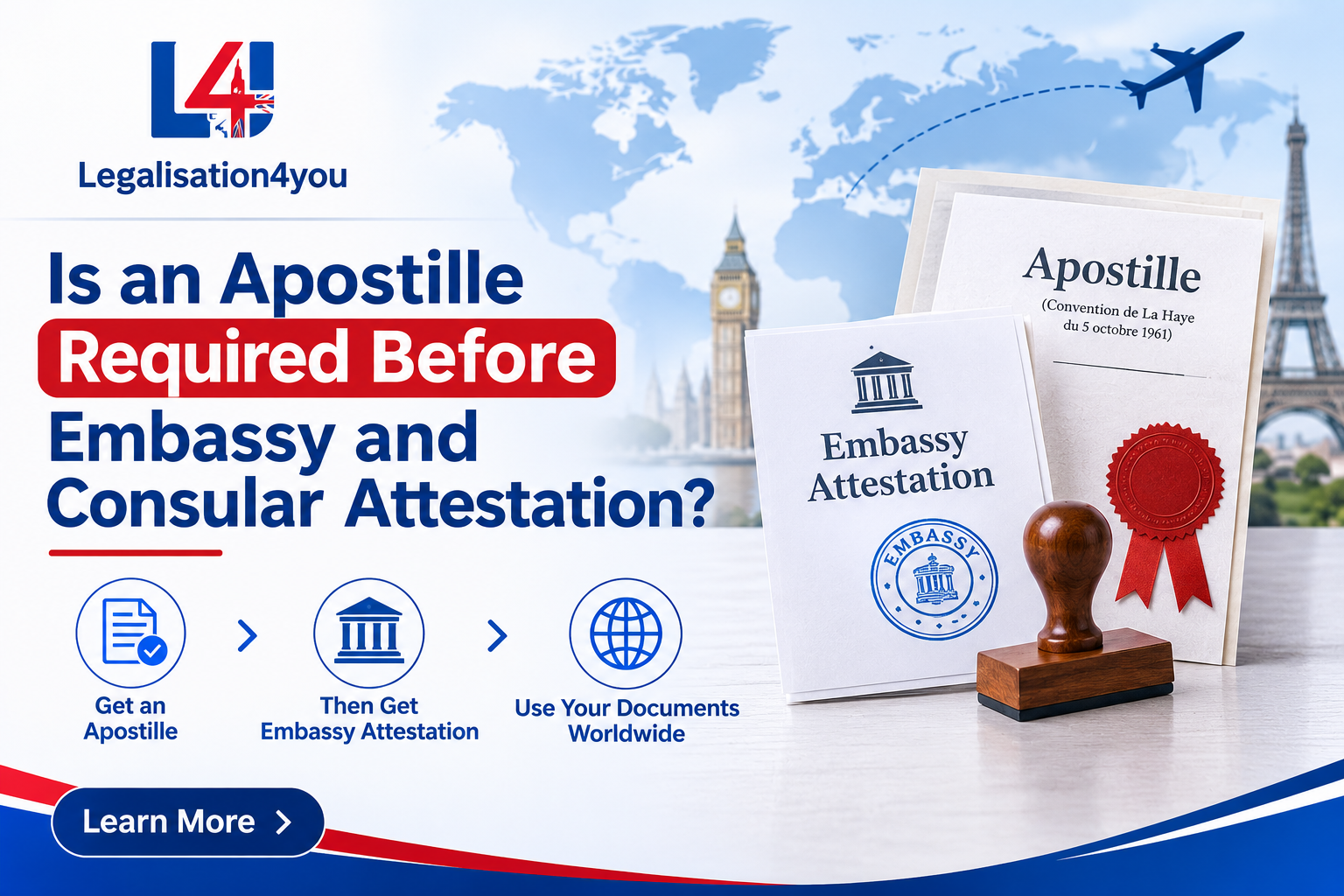
When preparing UK documents for use in another country, it is important to understand the legalisation process and the requirements of the destination country. Many people are unsure whether they need an apostille before applying for embassy or consular attestation. The answer depends mainly on where the documents will be used and the rules followed by the receiving country.
An apostille is an official certificate issued by the Foreign, Commonwealth & Development Office (FCDO) in the UK. It verifies the authenticity of a signature, stamp or seal on a public document so that it can be recognised in another country that accepts apostilles under the Hague Apostille Convention.
However, some countries require additional verification through their embassy or consulate after the apostille has been issued. Understanding these differences can help applicants avoid unnecessary steps, rejected applications and processing delays.
In this guide, we answer common questions about apostilles, embassy legalisation and the requirements for preparing UK documents for international use.
1. Is an Apostille Required Before Embassy and Consular Attestation?
In many cases, yes. If you are preparing UK documents for a country that requires embassy legalisation, the FCDO apostille is generally the first stage of the process.
The apostille confirms the authenticity of the relevant signature, stamp or seal on the document. After this verification, the document may need to be submitted to the destination country's embassy or consulate in London for further attestation.
This additional step is particularly relevant for countries where the Hague Apostille Convention does not provide a simplified legalisation route.
However, the process is different for countries that accept apostilles under the Convention. In these cases, an apostille is generally sufficient, and further embassy legalisation is not normally required.
Therefore, applicants should always confirm the requirements with the organisation requesting their documents before starting the process.
2. What Is an Apostille Certificate?
An apostille is an official certificate attached to a public document to verify the origin of that document for international use.
In the UK, apostilles are issued by the FCDO Legalisation Office. The office checks whether the signatures, stamps or seals on a document match its official records. If the details can be verified, an apostille is attached.
Common documents that may require an apostille include:
-
Birth certificates
-
Marriage certificates
-
Death certificates
-
Degree and educational certificates
-
Police certificates
-
Medical certificates
-
Powers of attorney
-
Company registration documents
-
Court documents
Not every document follows the same procedure. Some documents can be submitted directly, while others may need certification by a solicitor or notary public before they can be legalised.
An apostille verifies the origin of the document rather than confirming that its contents are factually correct.
3. What Is Embassy and Consular Attestation?
Embassy and consular attestation is an additional verification process that may be required when UK documents are intended for use in certain overseas countries.
During this process, the relevant embassy or consulate checks the apostille or other required authentication and applies its own legalisation stamp or certificate, depending on its procedures.
This step helps the receiving country's authorities recognise the document for official purposes.
For example, someone moving abroad for employment may need to submit a degree certificate, while a business may need to present company documents to an overseas government department.
The required procedure depends on the destination country and the document category. Some embassies may also request supporting paperwork, application forms, translations or additional certification.
It is important to check the relevant embassy's instructions before submitting documents.
4. Which Countries Require an Apostille Only?
Countries that accept documents under the Hague Apostille Convention generally use the apostille as a simplified alternative to traditional embassy legalisation.
If the UK document is eligible and the receiving authority accepts the apostille, further embassy attestation is generally unnecessary.
For example, an applicant preparing a UK birth certificate for use in a country that accepts apostilles may only need to obtain the FCDO apostille before presenting the document to the relevant overseas authority.
However, applicants should not assume that every document is automatically accepted without further requirements. The receiving organisation may still request a particular document format, certified copy or translation.
It is always advisable to confirm the exact requirements before applying.
5. Which Countries May Require Further Embassy Attestation?
Countries that do not use the Hague Apostille Convention process may require additional legalisation after the FCDO has issued an apostille.
In these situations, the general UK process involves:
-
Preparing the original document or arranging the required certification.
-
Submitting the document to the FCDO Legalisation Office for an apostille.
-
Taking the apostilled document to the relevant embassy or consulate in London.
-
Obtaining further approval from the Ministry of Foreign Affairs or another authority in the destination country, if required.
The exact procedure varies depending on the destination.
For example, documents intended for certain Middle Eastern destinations may require both FCDO legalisation and embassy attestation. Additional approval may also be necessary after the documents arrive overseas.
Applicants should check the latest instructions from the relevant embassy because requirements, fees and processing arrangements can change.
6. Do All Documents Need Notarisation Before Getting an Apostille?
No. Not all UK documents require notarisation before an apostille can be issued.
The requirement depends on the type and origin of the document.
For example, certain official documents issued by UK public authorities, such as birth, marriage and death certificates, may be submitted directly to the FCDO if they meet the relevant requirements.
However, private documents, copies of documents and certain educational or business documents may need certification by a UK solicitor or notary public before they can be legalised.
A notary public can perform different notarial acts, including witnessing signatures and certifying copies, depending on the document and its intended use.
Before arranging notarisation, applicants should confirm whether the receiving authority requires an original document, a certified copy or a notarised document.
7. Can I Apply for Embassy Attestation Without an Apostille?
For UK documents following the standard legalisation route for countries outside the Hague Apostille Convention, the FCDO apostille generally comes before embassy legalisation.
The relevant embassy may refuse to process a document if the required FCDO authentication is missing.
However, the procedure can vary depending on the country, document category and any specific arrangements between the authorities involved.
Some documents may follow special procedures, so it is important not to assume that every application has identical requirements.
Checking the embassy's current instructions before submitting your paperwork can help prevent unnecessary delays.
8. How Long Does the Apostille and Embassy Attestation Process Take?
Processing times depend on several factors, including the type of document, the FCDO service selected and the requirements of the relevant embassy.
The apostille stage and embassy legalisation stage have separate processing arrangements.
The overall timeframe may be affected by:
-
Whether the document needs notarisation or certification.
-
The FCDO's current processing time.
-
Embassy appointment availability.
-
Additional document verification requirements.
-
Public holidays and administrative delays.
-
Courier and delivery arrangements.
Applicants should allow sufficient time, especially when documents are needed for employment, immigration, education or business deadlines.
It is advisable to check the current processing estimates with each authority rather than relying on previously published timeframes.
9. What Happens If I Submit Documents Without the Required Apostille?
Submitting documents without the required authentication can result in rejection or delays.
For example, an overseas employer may refuse to accept a degree certificate if it has not been legalised according to the country's requirements. Similarly, a government authority may request additional verification before processing an immigration application.
If the apostille or embassy stamp is missing, applicants may need to retrieve their documents and complete the outstanding stages.
To avoid these problems, confirm the document requirements before submitting an application. Professional guidance can also help identify the correct legalisation route.
10. Can Personal, Educational and Business Documents Follow the Same Process?
Not always. Although the general legalisation stages may be similar, the preparation requirements can differ depending on the document category.
Personal documents: Birth certificates, marriage certificates, death certificates and police certificates may be required for immigration, marriage, residency and family applications.
Educational documents: Degree certificates, diplomas, academic transcripts and professional qualifications may require verification or certification before legalisation.
Business documents: Certificates of incorporation, powers of attorney, commercial agreements and company records may need notarisation or other authentication before they can be used overseas.
When arranging embassy and consular attestation, applicants should check the requirements for each document individually rather than assuming that one procedure applies to everything.
11. Can Translated Documents Also Require an Apostille?
Yes. Some overseas authorities require documents to be translated into their official language before accepting them.
The translation requirements depend on the destination country and the organisation requesting the paperwork.
In certain situations, the translation may need certification by a professional translator, solicitor or notary public. It may also need an apostille or further legalisation.
Applicants should confirm whether the receiving authority requires the original document, the translated version or both to be legalised.
Arranging translations in the correct format before starting the process can help prevent additional work later.
12. Why Should I Check Requirements Before Starting the Legalisation Process?
Every country has its own rules for accepting foreign documents. Even when two countries follow similar legalisation procedures, their requirements for document types, translations and supporting paperwork may differ.
Checking the requirements in advance helps applicants:
-
Identify whether an apostille is required.
-
Understand whether embassy attestation is necessary.
-
Confirm if notarisation or certification is needed.
-
Avoid submitting incorrect document formats.
-
Estimate processing times and additional costs.
-
Prepare translations and supporting documents in advance.
Getting the correct information before applying can make the entire process more straightforward.
Get Help With Your Apostille and Embassy Legalisation
Preparing documents for international use can involve several stages, particularly when both FCDO legalisation and embassy attestation are required. Choosing the correct process is important to avoid unnecessary delays, additional costs and rejected applications.
Legalisation4you provides assistance with UK document legalisation, including apostille services, notary services, solicitor certification and embassy attestation. Whether you need to legalise personal, educational or business documents, getting the right guidance can make the process easier to manage.
Visit to explore available services and get help preparing your UK documents for international use.